Notes on the parisian subterrain
I've been diving a bit more into this map, angling specifically towards using it to run a Bookholm campaign. Enromous caveat: I am an Anglo gamer chud with no archaeological or historical background; what follows is a repository of my dungeoncrawling-focused deciphering of French government(?) data using a combination of google translate and my partner who studied GCSE french. It is not an authoritative or even necessarily accurate work, but if you're looking to use the same resources I have to run a dungeoneering campaign, it may prove useful to you.
catacombs vs. mines
The 'catacombs' are actually a comparatively tiny, but disproportionately famous, section of the Parisian mines that were converted into an ossuary due to overflowing cemeteries.
The mines exist because of widespread, 'haphazard' mining practices, chiefly in the 12th century, that resulted in a great risk to the city's structural integrity. In 1774, a 30-metre section of road supposedly collapsed to a depth of 100(!!) feet. As a result, a comprehensive survey of both the cavities and mineral composition beneath Paris was/is highly necessary.
Enter the Atlas des Carrieres Souterraines (atlas of underground quarries).
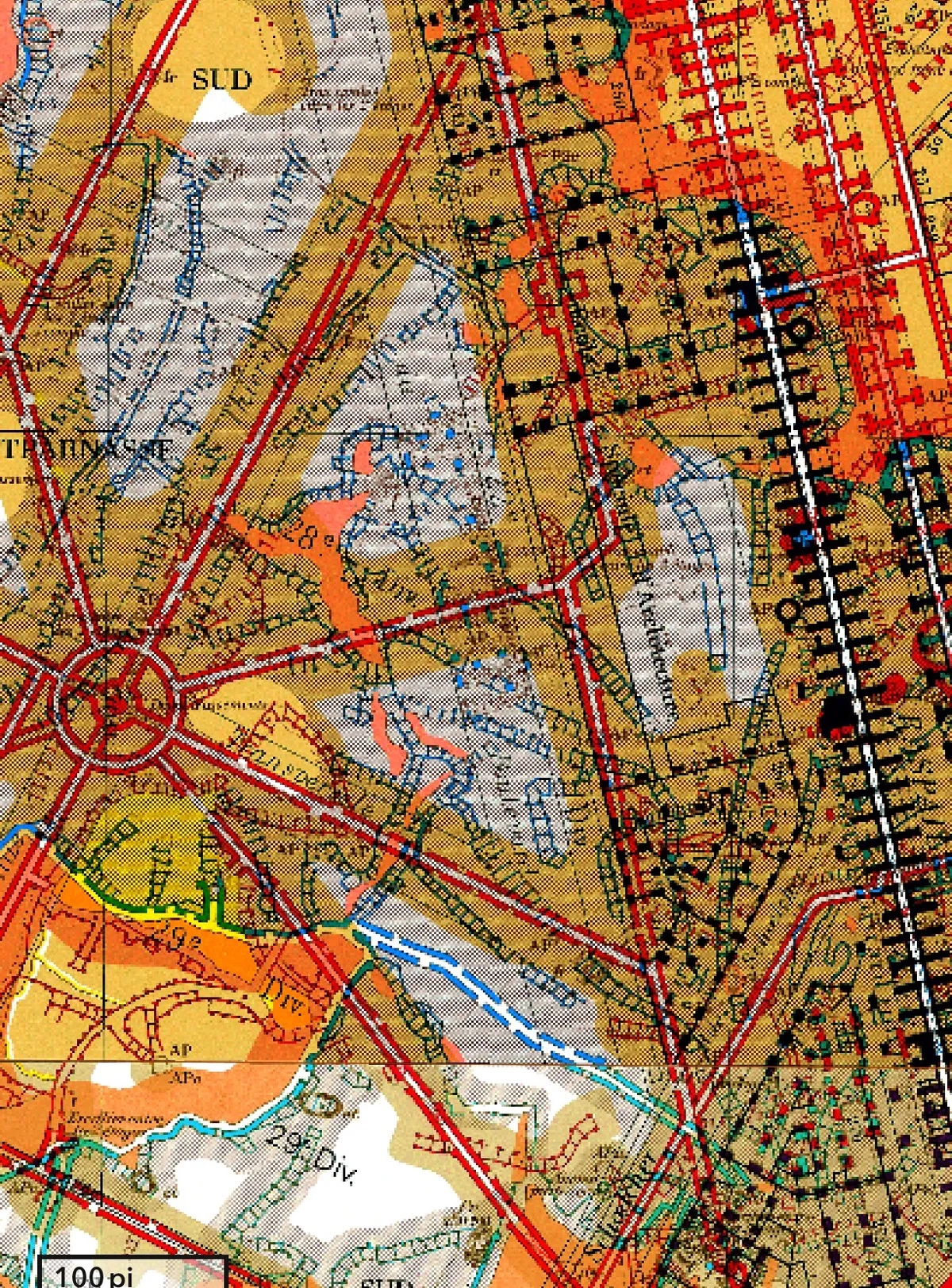
Initially, I had no clue of this map's purpose, and thus found it in equal parts to be fascinatingly dense and utterly intelligible1. This was not helped by the fact that it has no readily available legend. As far as I can tell, this is it. You can see that the legend is primarily concerned with labelling the different types of rock surrounding the tunnels, rather than the tunnels themselves. I found these cross section images particularly useful:
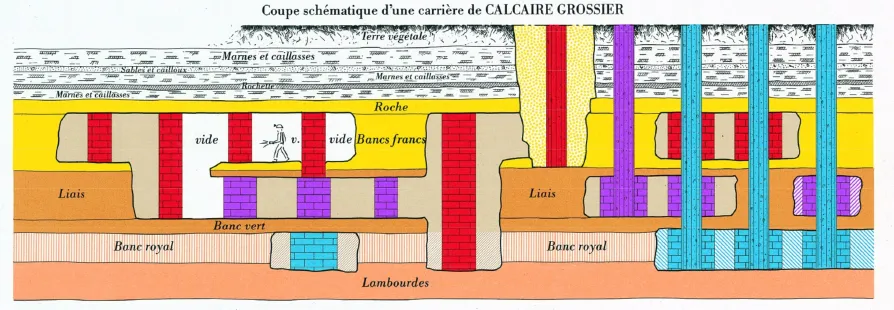
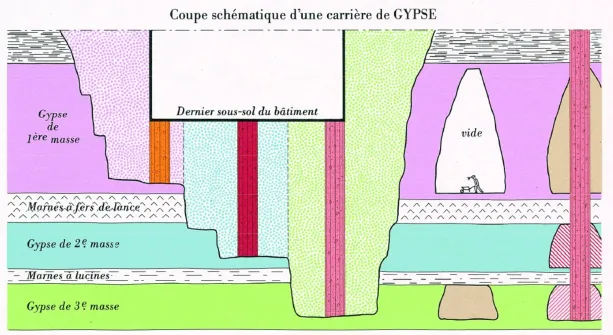
Knowing this, we can gloss over the blotches of different colours and focus on the white patches between them.
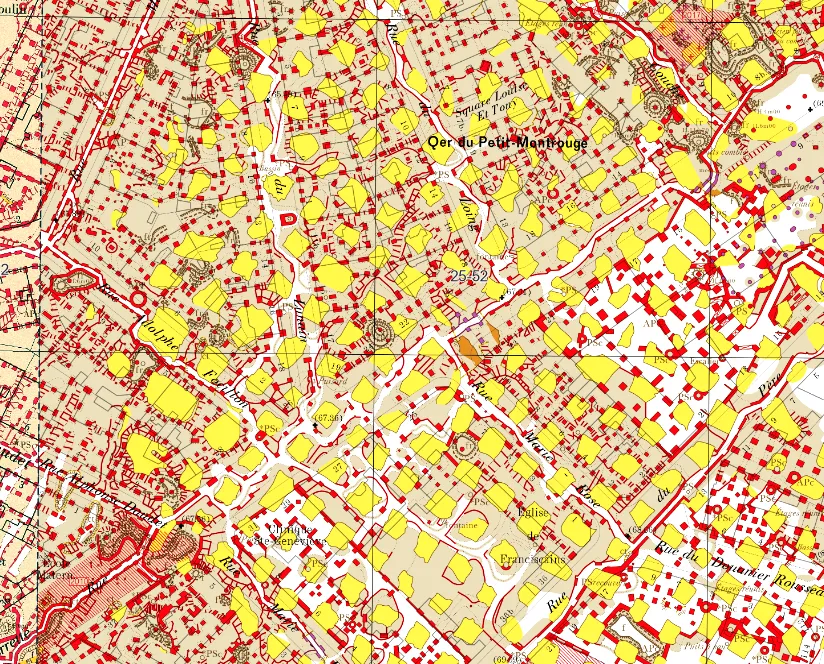
Therefore, what I can see in this image is a network of tunnels that wind between a mixture of backfilled rubble (the tan colour, bourrages) and a roughly gridded series of rock deposits that, for structural safety, cannot be dug out any further(the yellow colour, roche). Red parts are supportive masonry pillars.
is this usable?
Yeah, I think so. I even think I could use it right out of the box. The zoomed-out atlas is split into numbered boxes: 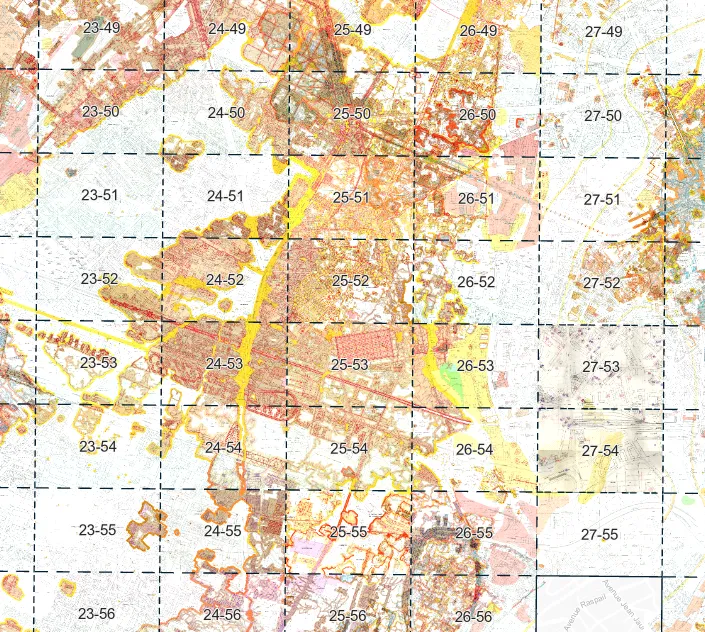
so all I'd need is to give the players a stamen map of Paris overlaid with the same grid, allowing me to roughly track where the players are in relation to the corresponding subterranean mines with a satisfactory level of granularity.
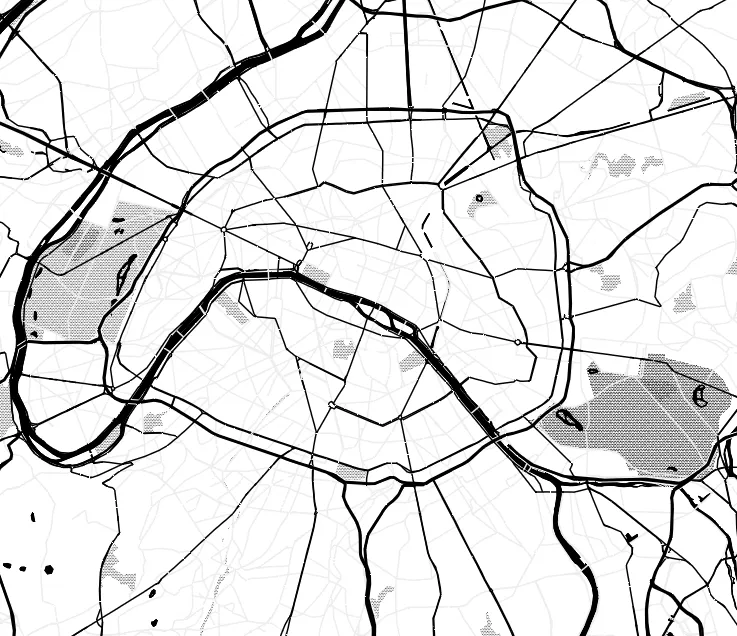
The main stumbling block is that none of these tunnels are particularly dungeon-y. Many are straight, or dead-ends, or boring grids, or un-Jaquaysed. So what do we do?
Multi-level Catacombs
The catacombs of Bookholm are extremely vertical. The Atlas, by contrast, is flat. This problem actually bears fruit: Wherever I wish, I can sprinkle in sub-levels that, in accordance with their deeper depth, are increasingly mythic, interconnected, and dungeon-y.
is this worth it?
It's an intoxicating prospect: The Atlas, a couple handouts, a few pre-keyed locations and mini-dungeons, and an array of random tables for locations, NPCs, and encounters are in theory all I'd need to kick off an awesome Bookholm campaign. But I am undecided on whether adapting Paris really be better than building my own catacomb network under this ready-made map from the book itself:
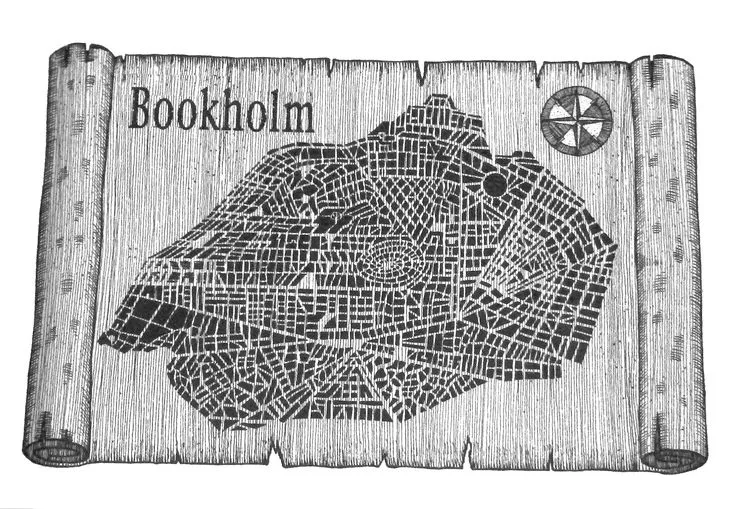
As I see it, the primary advantage in using the Parisian tunnels is having something deeply tangible and real to iterate off of. My hope is that the very structure of the Parisian tunnels will imbue catacomb-crawling with a certain solidity and tangibility that will ground the players a bit amidst the kaleidoscopy of Zamonia. Moers himself does this extremely well in his prose, treating the wild visions of his world with an encyclopedic seriousness.
In general, I find it way more fruitful to use real-life floorplans and maps. I'm not so sure if it'll be gameable, but I am growing gradually more disillusioned with this term as a useful descriptor of a map anyways.
Another advantage of using the catacombs is that Paris and its accompanying tunnels are way, way, way bigger than Moers' map. There's just more of it! This could easily be a downside, though: The substance of the city spread peper-thin. I think, however, that this danger is present and equal at both the Parisian and Moersian scales. The answer is to key important locations, have strong overviews on districts and key NPCs, and in all other cases, lay down the tracks ahead of the running steam train using robust tables and, uh, my ability to make shit up. I'll probably heavily lean on the excellent tables in Swyvers or adapt them, as I already have for other purposes.
A third and final consideration is that by doing this, I am taking a sideways step away from Bookholm as a pure adaptation of the contents of Moers' books, and Bookholm as something of my own. A true, faithful porting of the City of Dreaming of Books to the gaming table is impossible; Moers simply leaves too many gaps needing filled. Not only is it impossible, it wouldn't be fun. Bookholm has my heart, not because it is fully-realised, but because it inspires me to create. This, I feel, is also in keeping with the spirit of the city itself: of words, of inspiration, of synthesis, and of creation.
A more tunnel-focused map exists if you look for it, but I find is too overly editorialised for someone hoping to use the map as a blank slate for dungeon creation.↩